

Table Of Contents
Most applications or subcircuits require a constant voltage supply within a certain voltage tolerance range for proper operation. Battery-driven applications require voltage conversion to produce the desired output voltage as the battery discharges and the voltage drops. Applications powered by fixed power rails may also require voltage conversion if the available power rail is not suitable for the required input voltage or the voltage varies beyond the required tolerance range.
The following will discuss whether the buck-boost converter is an ideal solution for voltage conversion and whether it can be a universal tool for any type of DC/DC voltage conversion.
When to Use a Buck-Boost Converter
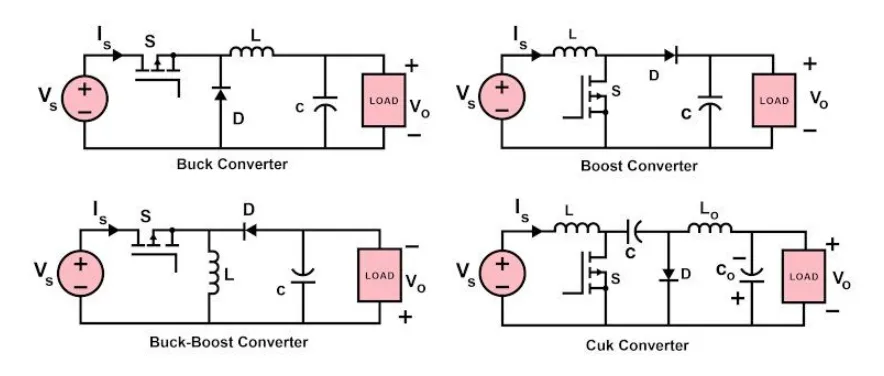
Generally speaking, if the available supply voltage for a circuit or subcircuit is lower than the required voltage, a boost converter can effectively convert the DC voltage to a higher voltage level. If the available supply voltage is higher than the required voltage, a buck converter will perform the voltage conversion.
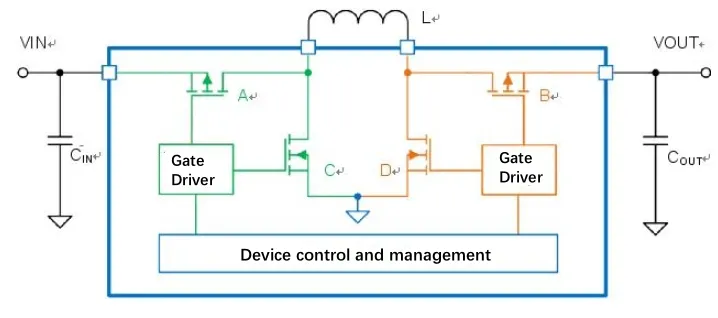
The buck-boost converter is suitable for applications where the supply voltage range is above and below the required output voltage. The buck-boost converter consists of a buck converter and a boost converter, and the block diagram shown in Figure 1 reflects its structure more clearly.
The buck-boost converter combines a buck converter with a boost converter in the same structure, which can effectively increase and decrease the output voltage. The control loop can decide whether the device needs to operate in buck or boost mode based on the actual input voltage and the programmed output voltage.
For example, suppose you want a lithium-ion battery with a typical voltage range of 4.2V to 2.8V to provide an output voltage of 3.3V. If you use a buck converter, the battery cutoff voltage must be greater than 3.3V, and the disadvantage is that the energy stored in the battery cannot be effectively utilized. The buck-boost converter helps to make full use of all the power of the battery because the buck-boost converter can also consume the stored energy when the input voltage is equal to or lower than 3.3V.
Using a Buck-Boost Converter as a Voltage Regulator
The second common use of a buck-boost converter is as a voltage regulator. If there are variations in the power rail and the load requires a more precisely regulated voltage, then a buck-boost converter is needed to stabilize the voltage. Tighter regulation may be required if components are sensitive to the supply voltage; if other DC/DC pre-regulators are not regulating tightly enough in industrial applications; or if other components in the power path increase voltage variations based on current. Using just a boost or buck converter will not solve this problem. However, a buck-boost converter is able to regulate the changing input voltage to the tighter limits required.
In summary, the buck-boost converter can be a universal tool for DC-DC voltage conversion to a certain extent, but its complexity, cost, electromagnetic interference and power limitation also need to be considered in practical applications. When selecting a voltage conversion tool, it is necessary to conduct a comprehensive evaluation based on specific application requirements, cost budget, electromagnetic compatibility requirements and power requirements to select the most suitable converter type.