
Table Of Contents
DC-DC converters are at the heart of modern electronic power supplies; they convert one voltage level to multiple other voltage levels. DC-DC converters can be used as the core IC of a unique design, but also as modules or building blocks. The latter two types provide a product that can be integrated into a larger power supply, eliminating much of the original design.
The dc-dc converter has long been an essential component to set and maintain operating voltages and improve efficiency while increasing power density. This summary update of an older device shows how it has changed to meet multiple drivers.
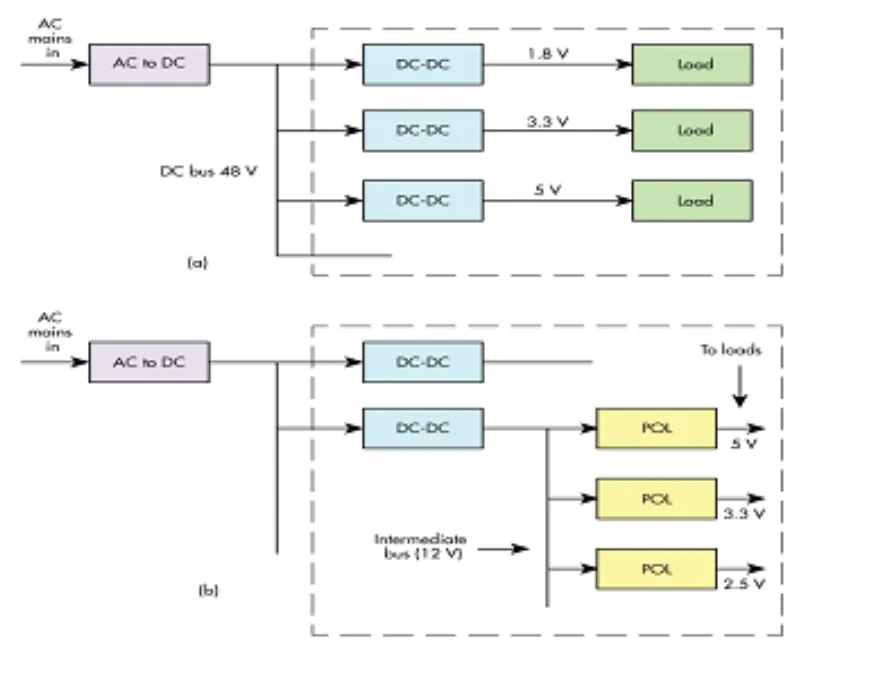
Today’s power systems use two main types of architectures: distributed architectures and intermediate bus architectures. The following figure also shows a distributed arrangement. Traditional AC-DC power supplies generate a main DC bus that is distributed to all parts of the device. The DC voltage required by ICs and other devices is generated by point-of-load (POL) DC-DC converters/regulators.
Trends and goals
There are several main drivers for dc-dc converter specifications and functionality. These drivers are a trend that is affecting power supply design today:
| Driving Factors | Details |
| Lower power voltage | Large MPUs, FPGAs, and ASICs are increasingly adopting extremely low core power voltages ranging from 0.6 to 1.8V. Meanwhile, the current drawn from these devices has sharply increased from dozens of amperes to hundreds of amperes. Some new devices operate at 1V or lower voltages and consume more than 500A. |
| Higher efficiency | Efforts to reduce energy consumption and heat levels have pushed efficiency to the top of priorities. Today, with the widespread application of various electronic devices, the problem of energy consumption is becoming increasingly prominent. Improving the efficiency of DC-DC converters can reduce energy waste and lower the operating cost of equipment. For example, in large power consumption scenarios such as data centers and communication base stations, efficient DC-DC converters can significantly reduce energy consumption and are of great significance for energy conservation and emission reduction. |
| Increased power density demand | Equipment miniaturization trend: The volume of electronic devices is continuously shrinking, which puts higher requirements on the power density of internal components. DC-DC converters need to achieve higher power output in a smaller space to meet the power supply needs of equipment. This prompts manufacturers to continuously research and develop and adopt new technologies and design methods, such as increasing the switching frequency and optimizing the circuit layout, to reduce the size of inductors, capacitors and other components and improve power density. Heat dissipation challenges and solutions: Increasing power density will lead to concentrated heat. Heat dissipation has become a key factor restricting the performance of DC-DC converters. Therefore, while increasing power density, effective heat dissipation technologies such as using materials with better heat dissipation performance and optimizing the heat dissipation structure are needed to ensure the stable operation of converters at high power density. |
| Increased reliability demand | In some application scenarios with extremely high reliability requirements, such as aerospace, medical equipment, and military equipment, the reliability of DC-DC converters is crucial. Once electronic devices in these application scenarios fail, it may lead to serious consequences. Therefore, DC-DC converters need to have high reliability, long service life, and good anti-interference ability to ensure the stable operation of equipment. |
Key drivers of DC-DC converter specifications
DC-DC converters play a vital role in modern electronic devices. Their low power supply voltage may be caused by many factors. The pursuit of higher efficiency is to meet the needs of different application scenarios. The transition to 48V has many advantages. Increasing power density can be achieved in many ways, while improving reliability faces many challenges. With the continuous development of technology, DC-DC converters will continue to be optimized and improved to better meet the needs of various electronic devices.