
Table Of Contents
Bidirectional DC converter (Bi-directional DC-DC Converter) is a power electronic device that can realize bidirectional transmission of DC power. It can not only convert DC power from one voltage level to another voltage level, but also transmit power in the opposite direction when necessary to realize bidirectional flow of energy. This converter is widely used in many fields, such as hybrid vehicles, DC uninterruptible power supply systems, new energy generation, smart grids, and electric vehicles. The following is a detailed description of bidirectional DC converter.
1. Basic concepts and working principles
Bidirectional DC converter is a DC-DC converter that can realize bidirectional flow of DC power. It uses power electronic devices such as switching devices and transformers to realize bidirectional transmission of power and voltage conversion by controlling the on and off time of the switching devices. This converter usually has a bidirectional conversion function of step-up and step-down, that is, it can realize step-up or step-down of power in different working modes.
In a bidirectional DC converter, the on and off time of the switching device is controlled by the control system, and the input signal of the control system usually comes from the sensor. When energy flows from one side to the other, the converter will work in boost mode or buck mode as needed. For example, in hybrid vehicles, when the battery supplies power to the motor, the converter works in buck mode; when the motor recovers braking energy and charges the battery, the converter works in boost mode.
2. Types and classifications
Bidirectional DC converters can be divided into many types according to their working principles and application scenarios. Common types include Buck-Boost, Cuk, Zeta, SEPIC, etc. In addition, according to different topologies, they can also be divided into full-bridge, half-bridge, and isolated types.
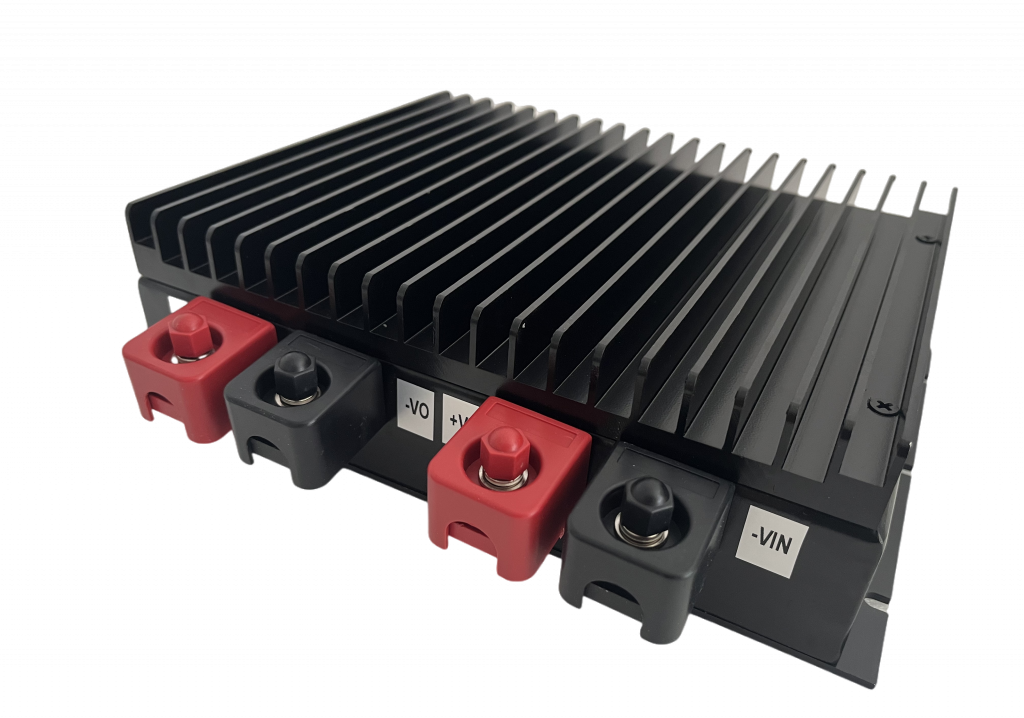
Buck-Boost: This is a basic bidirectional DC converter topology that achieves voltage rise and fall by changing the duty cycle of the switching device. It has a simple structure, but the polarity of the output voltage will change.
Cuk: The Cuk converter is also a common bidirectional DC converter topology that achieves voltage rise and fall by introducing additional inductors and capacitors. Compared with the Buck-Boost converter, the output voltage polarity of the Cuk converter does not change.
Zeta type: Zeta converter is another bidirectional DC converter topology, which can also realize bidirectional voltage conversion and the output voltage polarity remains unchanged. However, the circuit structure of Zeta converter is relatively complex and the cost is relatively high.
SEPIC type: SEPIC (Single-Ended Primary-Inductor Converter) converter is a single-ended primary inductor converter, which can also realize bidirectional transmission of DC power. SEPIC converter has the advantages of adjustable output voltage and common input and output.
In addition, according to whether electrical isolation is required, bidirectional DC converters can also be divided into isolated and non-isolated types. Isolated bidirectional DC converters achieve electrical isolation through isolation components such as transformers, which are suitable for occasions requiring high safety and reliability; while non-isolated bidirectional DC converters have relatively simple structures and low costs, but are slightly less